YouTube New Monetization Policy 2027: What Creators Need to Know ??
If you are a YouTube creator or planning to start your channel in 2027, understanding YouTube’s monetization rules is very important. With the growing use of AI and mass-produced content, YouTube is focusing more on original, authentic and valuable content. In this blog, we will understand the latest monetization updates, how AI content can affect monetization, what creators should avoid, and what Indian YouTubers should focus on to build a monetizable channel.
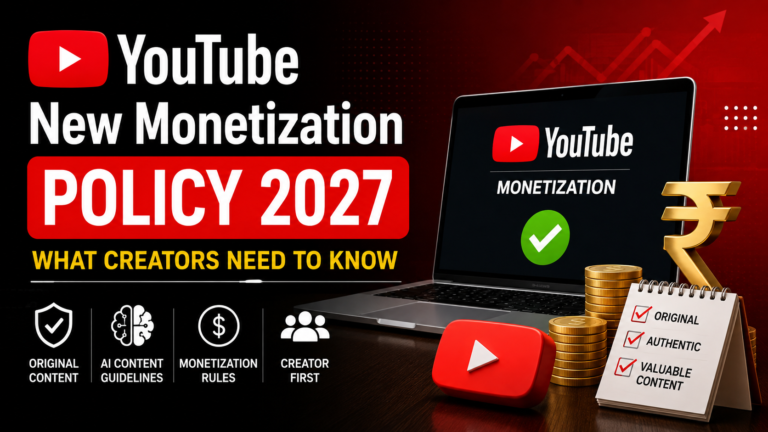
If you are a YouTube creator or planning to start a YouTube channel in 2027, monetization is one of the most important things you need to understand.
Many creators are already searching for YouTube New Monetization Policy 2027 because YouTube is continuously changing the way it reviews content, especially with the increasing use of AI.
But before we understand what may matter in 2027, one thing should be clear: YouTube has not announced a completely new separate monetization policy for 2027 as of now. The latest official updates show that YouTube is focusing more on original, authentic and useful content while taking action against mass-produced and repetitive content.
So, if you are creating videos with the aim of earning money from YouTube, you should understand these changes properly.
What is YouTube Monetization?
YouTube monetization means earning money from your videos through the YouTube Partner Program (YPP).
Once your channel becomes eligible for YPP and passes YouTube’s review, you can access different monetization options depending on your eligibility and the features available to your channel.
These can include:
- Advertising revenue
- YouTube Premium revenue
- Channel Memberships
- Super Chat and Super Stickers
- Super Thanks
- Other eligible monetization features
YouTube says creators must follow its channel monetization policies, Community Guidelines, copyright rules and advertiser-friendly content guidelines to remain eligible for monetization.
What is the Big Change Creators Should Know?
The biggest thing creators should understand for 2027 is original and authentic content.
In July 2025, YouTube updated its long-standing “repetitious content” guideline and renamed it “inauthentic content.”
YouTube clarified that content which is repetitive or mass-produced and gives little value to viewers is not eligible for monetization. YouTube also said that this type of content was already not eligible under its existing policies.
This means simply uploading a large number of similar videos is not a good monetization strategy.
For example, if a creator creates hundreds of videos using almost the same format, same narration style, same visuals and very little original value, the channel can face monetization problems.
Is YouTube Banning AI Content?
No.
This is one of the biggest misunderstandings among creators.
YouTube is not saying that every AI-generated video will be demonetized.
Instead, YouTube is focusing on whether the content provides value and whether it follows its monetization policies.
YouTube has also said that its systems are being developed to reduce the spread of low-quality, repetitive AI-generated content. At the same time, YouTube describes AI as a tool for creativity and expression rather than a replacement for creators.
So, using AI as a tool is not the same as creating low-quality content using AI.
For example, a creator can use AI for:
- Research ideas
- Script assistance
- Video planning
- Editing support
- Thumbnail ideas
- Voice or visual experiments
But the final content should still provide something useful and meaningful to the audience.
What About AI-Generated Videos?
This is especially important for creators planning to use AI heavily in 2027.
YouTube has introduced more visible AI disclosure labels for realistic AI-altered or AI-generated content. It has also started using automatic detection signals to identify significant use of photorealistic AI content in some situations.
However, YouTube clearly states that an AI disclosure label by itself does not automatically change whether a video is recommended or whether it can earn money.
The bigger concern is whether the content is useful, original and follows YouTube’s policies.
So, creators should not think:
“AI = No Monetization.”
The better way to understand it is:
“Low-value, repetitive and mass-produced content = Higher Monetization Risk.”
YouTube Monetization Eligibility
To join the main YouTube Partner Program for ad revenue, creators generally need to meet YouTube’s eligibility requirements.
Currently, YouTube lists two main paths:
Option 1:
1,000 subscribers + 4,000 valid public watch hours in the last 12 months.
OR
Option 2:
1,000 subscribers + 10 million valid public Shorts views in the last 90 days.
There are also earlier-access YPP features available in eligible regions with different thresholds. YouTube reviews the channel after the application and continuously checks monetized channels for policy compliance.
So, getting 1,000 subscribers does not automatically mean that your channel will be monetized.
Your content quality and policy compliance also matter.
What Content Can Create Problems?
If you want to keep your channel safe for monetization in 2027, you should be careful with content that is:
- Mass-produced
- Repetitive
- Copied from other creators
- Reused without meaningful transformation
- Created mainly to generate views without providing value
- Against Community Guidelines
- Not suitable for advertisers
- Using copyrighted content without proper rights
YouTube’s monetization policies also apply to Shorts, long-form videos and live streams.
This is why creators should not focus only on “How many videos can I upload?”
The better question is:
“How much value am I providing through every video?”
What Should Indian YouTubers Do in 2027?
For Indian creators, the basic strategy should be very simple.
1. Create Original Content
Try to add your own ideas, opinions, examples and experience to your videos.
If you are explaining a topic that is already available online, don’t simply copy the same information.
Explain it in your own way.
2. Don’t Mass-Produce Similar Videos
Uploading 50 or 100 videos is not useful if every video looks almost the same.
Focus on quality rather than only increasing the number of uploads.
3. Use AI as a Tool
AI can help you save time, but don’t depend on it to create everything automatically.
Use AI for support, but make sure your final video has your own value and purpose.
4. Focus on Your Audience
Ask yourself:
“Why will someone watch my video?”
If the answer is clear, your content has a better chance of providing real value.
For Indian audiences, this can mean explaining topics in simple English, Hindi, Hinglish or regional languages depending on your target audience.
5. Follow Copyright Rules
Using someone else’s video, music, images or other copyrighted material can create problems.
Even if a video gets views, that does not mean it is automatically safe for monetization.
YouTube can take action when content violates its copyright or monetization policies.
Will YouTube Monetization Become More Difficult in 2027?
It may become more important for creators to prove that their content provides genuine value, especially as AI makes it easier to produce content at scale.
But creators should not panic.
The direction of YouTube’s recent updates is not simply about stopping creators from using AI. It is more about reducing low-quality, repetitive and inauthentic content while supporting creativity.
So, if you are creating useful and original videos, there is no reason to stop creating content just because of these updates.
Final Thoughts
The YouTube New Monetization Policy 2027 should not be understood as a simple “new rule that will demonetize AI videos.”
As of now, YouTube has not announced a separate 2027 monetization policy. However, its recent updates clearly show that creators should focus on original, authentic, useful and audience-focused content.
AI can be used as a tool, but simply generating hundreds of similar videos is not a good long-term strategy.
If you are planning to build a YouTube career in 2027, start focusing on the right things now:
- Create original content
- Give real value to your audience
- Avoid repetitive content
- Use AI responsibly
- Follow copyright rules
- Follow YouTube’s monetization policies
- Focus on quality instead of only quantity
In simple words, YouTube is not only looking at how much content you create, but also at the value and authenticity of that content.
So, instead of trying to find shortcuts to monetization, focus on building a channel that people actually want to watch.
CTA
Want to learn more about digital skills, online opportunities and career-focused courses?
Vidya Sarthi can help you explore the right learning opportunities and take the next step towards building your skills.
Start learning, keep creating and stay updated with the latest digital trends.